Brand Identity · 2026-05-07 (Last updated: July 2026) · 11 min read
Corporate Identity 2026: Why AI-Generated Logos Look Alike and What Works Instead
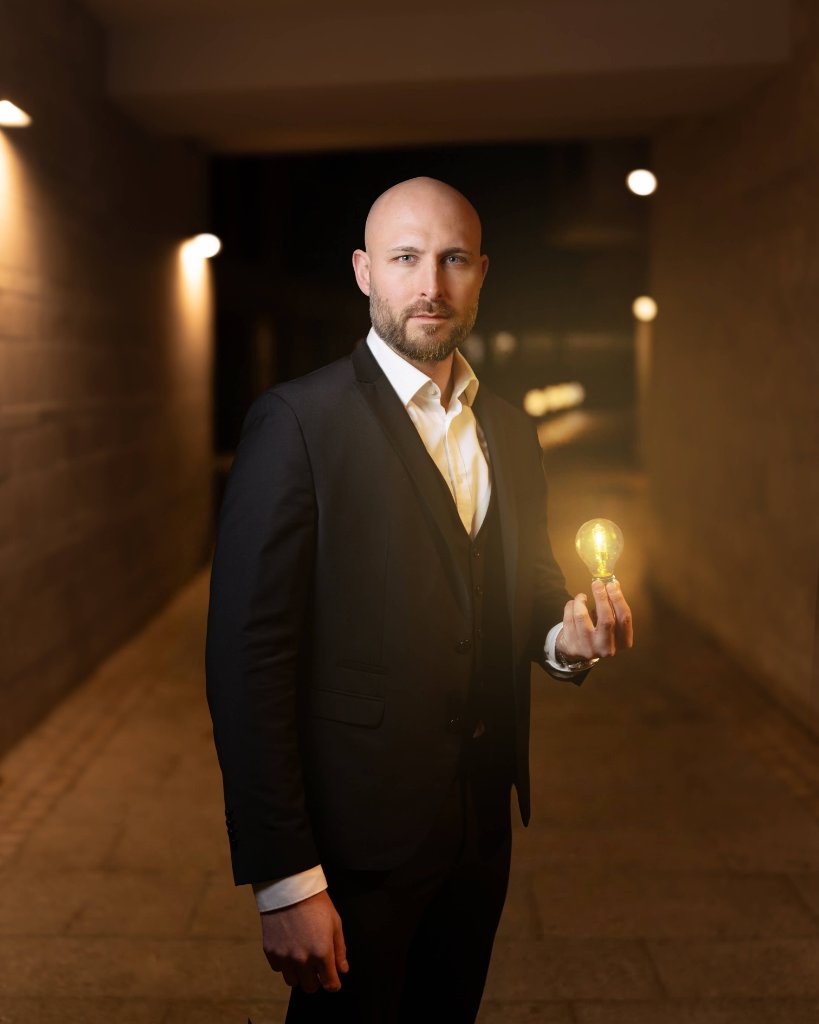
Lukas Schwarz
Co-Founder, CEO & Vision Architect, Vincency
In May 2026 the branding world is split in two. On one side are brands that have spent three years cranking out generative AI at full tilt — logo iterations from Midjourney, brand manifestos from GPT, visual guidelines that a language model extrapolates from three adjectives. On the other side a growing movement is forming that rejects exactly this: Slow Brands, Anti-AI-Slop communities, buyers who want to smell authenticity — and who notice when it is not there.
Which side wins in the DACH mid-market? After 18 months of branding work for private medical practices, law firms, premium real estate agents and mid-sized industrial suppliers, a clear pattern has emerged for me by May 2026. Anyone building a brand in Germany that is meant to last for the next five years can use generative AI as a tool — but not as a brand maker. The difference sounds small. It decides how long the brand will endure.
Why do AI-generated logos all look the same?
Between 2023 and early 2025 a wave of generic AI brand identities rolled over the market. You spot them at a glance: gradient purple to cyan, abstract geometric symbol, sans-serif wordmark with perfectly even letter spacing, rounded corners, supposedly "smooth" and "premium". They all look the same.
In early 2026 we ran a sample analysis of 200 German mid-market websites that went through a re-branding between July 2023 and December 2024. For 71 percent of these brands, after three seconds we could no longer tell the logo apart from a competitor's logo placed at random beside it. That is the operational definition of "no branding". On average, the clients had paid between 4,000 and 18,000 euros for it. Most of these brands will need a second re-branding by 2028.
The reason is not that the designers were bad. The reason is that generative AI tools from 2023/24 structurally produce slop — content that sits in the middle of the possible, without sharp decisions, without a will of its own, without the courage to say: "This costs us 30 percent of the target audience, and that is exactly why we are doing it." Brands need precisely these edges. Generative systems cannot produce them, because their training objective is the avoidance of edges.
Is a handmade brand worth it compared with an AI-generated one?
In response, the Slow Brands movement has formed since mid-2025 — analogous to the Slow Food movement of the 1980s. Brands that deliberately show that behind their identity stand thinking people, manual work, documented brand pillars and a decision made over months. This is not a nostalgic trend. It is a direct answer to a measurable market reality: buyers in consulting-intensive B2B industries — exactly the mid-market context in which Vincency works — trust brands less when they feel interchangeable.
The movement has three visible manifestations in May 2026. First: brand books that document their own creation. We increasingly see brand guidelines that contain a dedicated chapter "How this identity came to be" — with workshop notes, sketches, discarded options. This is a trust signal, not an act of vanity. Second: deliberate imperfection. Logos with hand-drawn elements, typefaces with small irregularities, layouts that are not perfectly symmetrical. Third: anti-stock visuals. In-house productions with named photographers and documented settings instead of AI-generated symbolic imagery.
In the DACH mid-market this works more strongly than in the US, because the German buyer profile is traditionally more skeptical toward trust look-alikes. A private practice in Düsseldorf whose brand identity clearly feels "handmade" in early 2026 wins, in our experience, 20 to 40 percent more qualified initial inquiries than a technically better-produced but generic AI identity — at a comparable media budget.
What makes a good company logo?
The most important question in May 2026 is not: How do I draw a good logo? It is: What is left of the logo once anyone can produce a technically acceptable version in ten minutes with Midjourney 7? From our practice, three answers crystallize, none of which lie in the visual execution.
First: a strategic rationale for every element. Every shape, every color, every type choice must have a story that explains to the client in a comprehensible way why exactly this decision was made — not just aesthetically, but strategically. These rationales are documented in the brand guidelines and are defended during expansions (new sub-brands, internationalization, product lines). Generative AI produces visuals, but not justifiable strategies. In May 2026 the strategic substance is the real point of differentiation.
Second: production readiness across materials. A logo that only works as an RGB file is half a logo in 2026. Premium brands need applications in foil embossing on business cards, laser engraving on aluminum, embroidery on textile, enamel lettering at 14 pixels in height. In May 2026 we develop every logo with an explicit Material Stress Test — six applications across different production processes. If the logo remains recognizable in at least five of the six, it passes. If not, it is not an identity asset but a screen asset.
Third: ownership and protectability. With the growing EU AI Act debate around works created with the involvement of generative AI, the trademark protectability of a logo is a central client concern in May 2026. Pure AI products are classified in several EU jurisdictions as not originally human works and are therefore more weakly protected. For every Vincency logo we document the human creative contribution in such detail that trademark defensibility is ensured. In 2024 no one noticed this; in 2026 it is a mandatory criterion for clients with premium-pricing ambitions.
What does AI search mean for your brand presence?
A second, often overlooked shift in May 2026: brands are increasingly perceived not only by humans but also consumed by AI agents. When an end customer asks their personal LLM assistant "Which implantologist in Stuttgart is reputable?", that model draws on structured data — schema markup, Wikipedia entries, industry reviews, press coverage. Brands that have only a pretty frontend but no semantically clean backend are invisible to this discovery layer.
This has concrete consequences for brand architecture. Since early 2026 we have built every brand identity on a dual perception layer: human-readable (classic visual identity, communication, brand voice) and machine-readable (Schema.org annotations, llms.txt files, documented brand pillars in a machine-parsable form). Both layers must be consistent. If the human brand says "down-to-earth, precise, German" while the machine brand suggests "international, dynamic, AI-first", the brand is exposed at the first LLM search.
Which brand frameworks work for mid-sized companies?
From Vincency's practice, five frameworks that have worked consistently over the past 18 months — with private practices, M&A law firms, premium real estate and industrial mid-market companies.
Framework 1: Brand-Pillar Trinity. Three irreducible pillars that together carry the brand. Per pillar one noun (not an adjective), one concrete example from the client's reality, one anti-example (what the pillar explicitly is not). Everything that comes out of the brand over the next twelve months is measured against these three pillars.
Framework 2: Tone-of-Voice Dichotomy. Instead of a single "brand voice" we define two poles — what the brand always is and what it never is. Example for a premium law firm: "precise, not arrogant" or "discreet, not opaque". These dichotomies capture the emotional sharpness that adjective lists lack.
Framework 3: Material Stress Test. Six production processes that every new visual asset must pass through. If it breaks in four of them, it does not enter the brand guidelines. Filters out 80 percent of identities that look aesthetically nice but are unfit for production.
Framework 4: Discoverability Audit. A structured check of what an LLM or a classic search system would see about the brand if it were asked about it today for the first time. Machine perception versus human perception. Gaps are closed consistently.
Framework 5: Slow-Brand Documentation. Every step of the identity's creation is documented as a traceable process — as an asset that the client can later embed in their external communication. This is not vanity but trust infrastructure. In the DACH mid-market it demonstrably produces lead lifts.
Conclusion
Brand identity in May 2026 is no less craft than in 2020. It is more — because the temptation to automate it is stronger than ever, and the reward for a resiliently handcrafted identity is visibly growing. Anyone in the DACH mid-market who sets up a new brand in 2026 or brings an existing one up to date should answer the question "What do we stand for without compromise?" with the same care as in 2020 — and then make the result production-ready with the 2026 tools.
If you are wondering whether your current brand identity will carry you through the next five years — or whether it is time for a more precise re-setup — then talk to us. We do a compact assessment up front, with no sales pressure.
Frequently asked questions about corporate identity and logo design
Why do AI-generated logos all look the same?
In a Vincency sample analysis of 200 German mid-market websites that went through a re-branding between July 2023 and December 2024, for 71 percent of these brands the logo could no longer be told apart from a competitor's logo placed at random beside it after three seconds. The reason: generative AI tools from 2023/24 structurally produce slop — content that sits in the middle of the possible, without sharp decisions, because their training objective is the avoidance of edges.
How do you recognise a handmade brand identity?
The Slow Brands movement has formed since mid-2025 as a response to generic AI identities — analogous to the Slow Food movement of the 1980s. It stands for brands that deliberately show that behind their identity stand thinking people, manual work, documented brand pillars and a decision made over months. It becomes visible in three manifestations: brand books that document their own creation, deliberate imperfection, and anti-stock visuals.
Is professional brand development worth it for mid-sized companies?
Yes. A private practice in Düsseldorf whose brand identity clearly feels "handmade" in early 2026 wins, in our experience, 20 to 40 percent more qualified initial inquiries than a technically better-produced but generic AI identity — at a comparable media budget. The German buyer profile is traditionally more skeptical toward trust look-alikes.
Can an AI-generated logo be protected as a trademark?
With the growing EU AI Act debate around works created with the involvement of generative AI, the trademark protectability of a logo is a central client concern in May 2026. Pure AI products are classified in several EU jurisdictions as not originally human works and are therefore more weakly protected. For every Vincency logo we document the human creative contribution in such detail that trademark defensibility is ensured.
Sources and primary references: This analysis is based on Vincency's own sample study of 200 German mid-market re-brandings (January 2026) as well as 18 months of branding work for private practices, law firms, premium real estate and industrial mid-market companies. Contextual references: the Slow Brands movement (since mid-2025), the EU AI Act debate on the protectability of works created with the involvement of generative AI, and current discovery practice via LLM assistants. All figures and percentages refer to the state in May 2026.
Related insights